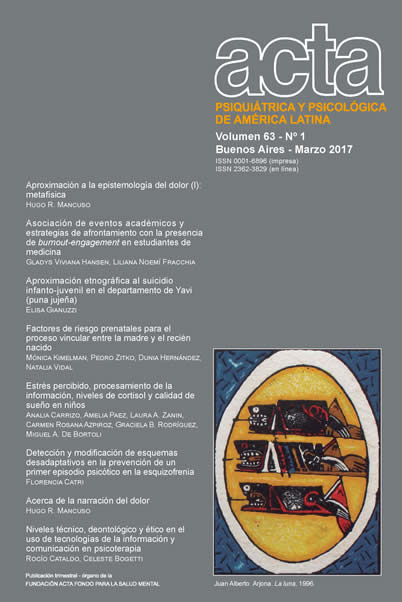
On the Narrative of Pain
Keywords:
Interiority , Narrative, EthicsAbstract
Prima facie, "narrative" and "interiority" are two terms that contradict and neutralize themselves. To narrate indicates externalization: "to speak", "to say", "to tell", in short, the language. By contrast interiority connotes our "private space", the privacy of our emotional and intellectual life that no one knows, not even the holder. L. Wittgenstein, by inviting us to observe the grammar of the words that represent interiority, ―"mind," "pain," "thinking," "remembering," "understanding", "meaning"― puts into play an operation of demystification and deconstruction, which unmasks the occult mythology (the fetishism itself) of this narrative. The linguistic and conceptual analysis of interiority (or inner morphology) understood as a genealogy of the forms, shows the narrative structure of interiority within which the singularity of each one is revealed. a structure, not of interpretation (finite) but of interpretability (infinite/unlimited), in other words, a mechanism of signic production and not a mere normative lexicon of corresponding verification of uses and meanings.